


If you own or manage a Service business, learn ‘how NOT to alienate’ your customers!
Summary:
Are the five dimensions of the conventional ServQual model adequate in measuring customer perceptions of service quality, in the service context of the present digital era?? The article argues that a sixth dimension must be added for services in the present digital era.
ServQual – an overview
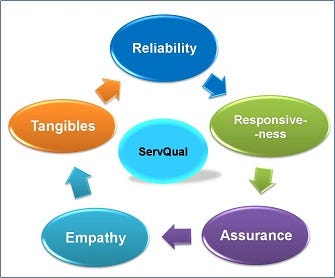
Most of us are familiar with ServQual model1, an empirical method for measuring customers’ perceived quality of a firm’s service and comparing it with their service needs (of the firm’s service) or with competition or over time. It is based on five dimensions of service quality: Tangibility, Reliability, Responsiveness, Assurance and Empathy. Each of these five dimensions is broken down into a number of service attributes, which are considered important for a particular service. Over a period of time, service researchers have suggested several modifications to the methodology, but the basics of the model are well-accepted.
Context of Digital Era Practices
Several research and commercial studies have been conducted on ServQual in a variety of services such as retailing, banking, airlines, telecom, education, healthcare etc., essentially based on the five dimensions proposed by the authors of the model originally. I would like to examine the inadequacy of the model for measuring service quality in the present context of digital era, with major customer-facing functions being automated or shifted to call centres, in order to cut costs of customer support. The primacy of customer-oriented business practices has taken a back seat in several services and this necessitates a relook at how we measure ServQual.
Business Practices - Telecom Services
Let me take the example of the Indian telecom industry to illustrate my viewpoint. While I am making these comments in respect of the Indian telecom sector, several friends of mine in different countries (including the ‘developed’ ones) tell me that the picture is not very different there!
The telecom sector abounds with examples of degeneration of business practices, which are very often unfair and even hostile to customers. Conventional CRM (customer relationship management) principles dictate that, in service situations, wherein the customer’s lifetime value (look for my forthcoming articles and resources on the subject) is high to the firm, business practices should be oriented towards retaining existing customers. CRM further advocates favourable treatment of loyal customers. The obvious logic of this diktat is that it is costlier to acquire and serve a new customer, as compared to an existing customer.

But, we see several instances of telecom firms adopting business practices which undermine existing customers. Some of them charge even for complaint calls made to their call centre. At your cost, they keep playing to you, for several minutes, pre-recorded audios on how great their value added services are and how easy it is to subscribe to each of the VA services … while you fret and fume, waiting for someone to answer you and listen to your complaint! Is this not plainly unethical, apart from being unresponsive?
Even if you incur the charge and manage to make the call to the call centre (they make sure you don’t get through in anything under five attempts), usually the complaint is not satisfactorily resolved – you feel that you are talking to a stone wall. Most often, either the call centre representative does not understand what you are saying or pretends not to understand. You get the distinct feeling that the representative has no intention of solving your problem. I would stick my neck out and say that the call centres are deliberately staffed with people whose capabilities are questionable. The behaviour is deliberately cultivated to discourage number of complaint calls. In many instances, they are even trained to stonewall customer complaints. ‘Make it extremely difficult to complain’ seems to be the motto of telecom companies. Is this not plainly dishonest, apart from being unresponsive and lacking in assurance?
There was a period of time, when a particular service provider had a network outage for nearly a week, but yet the company did not give a rebate for service charges to post-paid customers. Some customers who threatened to take them to court got a partial remission, but not in full. The argument put out was that remission is counted only from the time you complained. The customer’s explanations that it was very difficult to get across to the call centre were summarily rejected. Is this not both unethical and unfair to customers, apart from the service being unreliable and the complaint handling unresponsive and non-empathetic?
Consider this broadband service provider, who signs up customers at a fancy monthly fee for an unlimited fast browsing plan. The actual speed is not even 50% of what is promised. After several months, the company then goes on to acquire several thousands of new customers at a discounted price, promising even a higher speed. Then it goes on to inform its existing customers, who have signed up months or even years before, and are paying a higher rate, that after a certain amount of download, their speed will be reverted to half of the plan speed (this restriction is not applied to new customers). And they do this in the most irritating manner possible – not by email or sms or landline call. When the customer switches on the broadband connection and types in any url (let us say an email service), they replace the url with their own splash page url. All this is blatantly unethical, unfair and even illegal, apart from being unreliable and unresponsive.
Recently I had a first hand experience of the low level of customer support in this industry. I had called the customer support representative and asked for placing my wi-fi broadband service in ‘safe custody’ for a few months and reconnection on my return, as I was going abroad on vacation. I gave the person clear dates for start of safe custody and restoration of service. Customer support representative readily agreed to do this, but I get an email after a few days saying how sorry they were to lose me as a customer and ‘would I please fill out a survey on my erstwhile experience with their service?’. All this, while there is a huge balance in my account still!
Other Services
Lack of ethics in dealing with customers is not just confined to telecom industry. Let me just cite a recent example in healthcare. Consider this corporate hospital, charging fancy fees for any service, conducting a rather painful and discomforting procedure on a patient, without the doctor briefing either the patient or the accompanying relatives on the pre and post procedural requirements, implications and effects. The procedure places a monitoring implant, which stays for a day, and test results are to be downloaded from the implant, when it is removed next day. But, the patient is not told what requirements must be fulfilled to facilitate the monitoring. The test is, of course, a failure and the patient has not only undergone acute discomfort, but is also poorer by a few thousand rupees. The doctor does not even feel a tinge of remorse or responsibility. He does not even bother to offer redoing the test. In other words, he is not primarily concerned about his patient’s welfare, but only in collecting his fat fees through as many procedures in a day as possible – he collects a percentage from the hospital. Would you just call this unresponsive and unreliable, or is it a case of criminal apathy? Should the patient take this doctor or the hospital or both to court?
I am told by my friends of a very advanced (!) country that the quality of healthcare is much worse in their country!
Examples abound in every type of service, wherein the conduct of the service provider does not only fail basic requirements of ServQual dimensions, but involves mala fide – a deliberate behaviour to short-change the customer.
Suggestion to Service Providers, Consultants & Researchers
We now seem to be in an era of degenerated business ethics, which affect customers adversely. The remedy for this may be a stronger regulatory regime or a mass consumer awakening, as witnessed in U.S. a few decades ago, thanks to Ralph Nader. But what is the take for service market research agencies and academic researchers of services management? Is it time to add a sixth dimension to the ServQual – namely Ethics and assign a high weightage for this dimension?I I would also suggest that scaling be modified to make a negative score possible for each ServQual attribute: that is, redefine the scoring scale as -10 to +10, instead of the conventional 0 to 10 scale. This will help customers assign a score below zero, if on that service attribute, the firm does not even come up to minimum customer expectations.
If these changes, in the way ServQual is measured, are adopted, would the customer apathetic service firms be able to flaunt high customer satisfaction scores, based on surveys by reputed agencies like IMRB, ORG, Nielsen or J.D. Powers? And would it help in portraying the companies, which really care about ethics in dealing with customers, in much better light, with much better ServQual scores than their unethical competitors?
As for lessons to be learnt, from these narratives, by Service Startups, Providers and Businesses:
Create a charter of Ethics for your Service Business and conduct a thorough, periodic audit (preferably through a good agency) of all parts of your service offerings and locations
Ensure that your Operations, Customer Support and Call Centres are tightly integrated in terms of seamless systems and staff training
Let the CEO of the Service Business spend the first few minutes in office every day, scanning the ‘exception reports’ of Customer Support
I look forward to a lively debate through comments on this article.
I will meet you in another ‘insightful’ article soon! Take care!
Prof. Bala
